

U.S. Light Therapy Market Growth Steady at 4.9% CAGR Through 2032 | Persistence Market Research
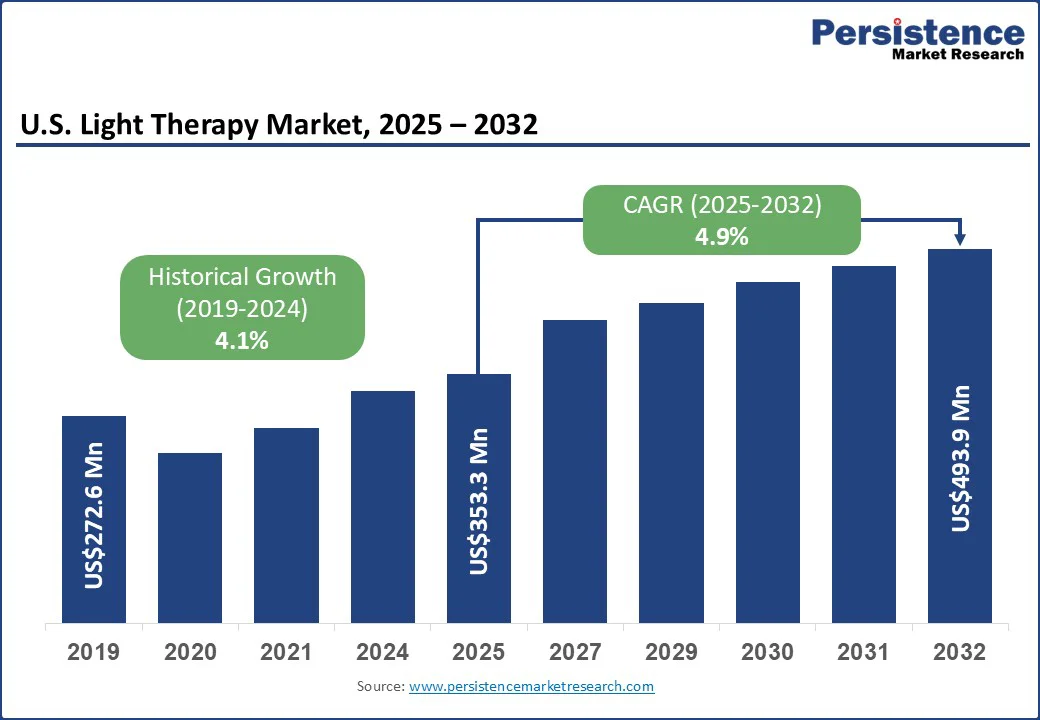
U.S. light therapy market
The U.S. light therapy market is growing due to increased awareness of mental health, sleep issues, and skin conditions, with a focus on home-based treatments.
LONDON, UNITED KINGDOM, March 5, 2026 /EINPresswire.com/ -- The U.S. light therapy market is poised for substantial growth, expected to reach a value of US$353.3 million in 2025 and is projected to grow to US$493.9 million by 2032, expanding at a compound annual growth rate (CAGR) of 4.9% during the forecast period from 2025 to 2032. This growth is driven by a rising awareness of mental health and sleep hygiene, increasing prevalence of lifestyle-related sleep disturbances, and a shift towards non-pharmacological treatments for chronic conditions.
Download Your Free Sample & Explore Key Insights: https://www.persistencemarketresearch.com/samples/35631
Key Industry Highlights
Fastest-Growing Product Type: Handheld devices are emerging as the fastest-growing segment due to their portability, affordability, and ease of use in home-based therapies for skin, mood, and sleep-related issues.
Leading Application Type: Skin conditions are expected to account for 34.7% of the market share in 2025, driven by high prevalence rates of acne, psoriasis, eczema, and vitiligo, along with the growing clinical acceptance of light therapy as a non-invasive treatment option.
Dominant End-user: Home healthcare will dominate the market with an estimated share of 61.1% in 2025, driven by convenience, self-care trends, and increased use of light therapy for everyday wellness.
Emerging Opportunity: Wearable light visors and app-integrated solutions are gaining traction, fueled by consumer demand for mobility, real-time therapy tracking, and integration with digital health systems.
Market Growth Factors
Mental Health and Seasonal Affective Disorder (SAD)
One of the main factors driving the growth of the light therapy market is the increasing awareness of mental health issues, particularly Seasonal Affective Disorder (SAD). Approximately 5% of U.S. adults experience full SAD annually, while an additional 10-15% report milder seasonal mood disturbances. Furthermore, 13% of adolescents and adults face depressive symptoms within any two-week period, highlighting a significant segment of the population that benefits from non-drug interventions such as light therapy.
Challenges: Lack of Standardized Treatment Protocols
Despite the potential of light therapy, there is a significant challenge in the U.S. market: the lack of standardized treatment protocols. Treatment durations, light wavelengths, and energy levels vary widely, complicating the development of consistent, effective treatment plans. For instance, the World Association for Laser Therapy (WALT) has proposed dosage guidelines, but these recommendations differ greatly across treatment types.
The FDA has also increased its focus on the need for strong clinical evidence to support at-home phototherapy claims for conditions such as acne and psoriasis. This regulatory scrutiny demands more robust clinical trials, which could delay product availability and increase costs, hindering the growth of the light therapy market in the U.S.
Get Custom Insights Designed for Your Business: https://www.persistencemarketresearch.com/request-customization/35631
Rising Prevalence of Skin Disorders
The increasing prevalence of skin disorders in the U.S. presents a significant growth opportunity for light therapy. Skin conditions such as acne, psoriasis, and eczema affect a large proportion of the population, creating consistent demand for non-invasive treatment options like light therapy.
According to the National Center for Complementary and Integrative Health, skin diseases affect one in three Americans at any given time. The FDA-cleared phototherapy devices for acne and psoriasis further bolster light therapy's position as a preferred treatment. However, inconsistencies in light wavelength, exposure time, and treatment parameters still pose challenges in ensuring efficacy and safety.
Product Type Insights
Handheld Devices
Handheld devices are leading the market with an estimated 27.6% share in 2025. These devices are particularly popular for home-based therapy, offering portability, affordability, and versatility. Unlike large clinical units, handheld devices allow consumers to administer treatments conveniently at home, making them highly appealing to tech-savvy users who seek non-invasive solutions for skin conditions such as acne, wrinkles, and hyperpigmentation. Many FDA-cleared handheld devices offer multi-mode functionality, supporting red, blue, and infrared light in a single unit, which enhances their appeal in multiple wellness and therapeutic applications.
Application Insights: Skin Conditions
Skin conditions are expected to dominate the U.S. light therapy market with a 34.7% market share in 2025. Light therapy is effective in treating common skin conditions such as acne, psoriasis, eczema, and fine lines. Treatments involving red, blue, and near-infrared wavelengths have been shown to reduce inflammation, kill acne-causing bacteria, and promote collagen production.
In addition to therapeutic uses, light therapy is gaining popularity in the aesthetic market, with increasing consumer interest in anti-aging treatments. FDA clearance of various home-use devices has made these treatments more accessible, driving their adoption among consumers.
Competitive Landscape
The U.S. light therapy market is highly competitive, with key players including Joovv, Verilux, and HoMedics. These companies focus on innovating their product offerings with features like multi-wavelength functionality, portability, and FDA clearance for home use. Emerging players are targeting niche markets by offering affordable and user-friendly solutions, catering to both clinical and at-home consumers.
Key Industry Developments
Recent developments in the light therapy market underscore its expanding role in healthcare. In August 2025, MITO Red Light Therapy highlighted the growing need for photon supplementation due to lifestyle factors such as limited sun exposure.
Moreover, in March 2024, Celluma Light Therapy launched a new body contouring device, further expanding its product portfolio. These advancements indicate a bright future for the U.S. light therapy market, with continuous innovation driving both clinical and consumer adoption.
Checkout Now & Download Complete Market Report: https://www.persistencemarketresearch.com/checkout/35631
Market Segmentation
By Product Type
Handheld Devices
Floor and Desk Lamps
Light Boxes
Light Therapy Lamps
Light Visors
Others
By Application
Skin Conditions
Mood & Sleep Disorders
Sleep Disorders
Others
By Light Type
Blue Light
Red Light
White Light
Others
By End-user
Home Healthcare
Dermatology Clinics
Others
Read Related Reports:
Hair Transplant Services Market: The global hair transplant market size is projected to grow from US$7.9 Bn in 2026 to US$11.3 Bn by 2033, registering a 5.2% CAGR during forecast period.
Skin Rejuvenation Market: The global skin rejuvenation market is set to grow from US$2.0 Bn in 2026 to US$3.5 Bn by 2033, registering a strong 8% CAGR during 2026–2033.
Persistence Market Research
Persistence Market Research Pvt Ltd
+1 646-878-6329
email us here
Visit us on social media:
LinkedIn
Instagram
Facebook
YouTube
X
Legal Disclaimer:
EIN Presswire provides this news content "as is" without warranty of any kind. We do not accept any responsibility or liability for the accuracy, content, images, videos, licenses, completeness, legality, or reliability of the information contained in this article. If you have any complaints or copyright issues related to this article, kindly contact the author above.
