

Prussian Blue Cathode Precursors Industry Outlook: Market Expansion and Price Trend Analysis (2026–2036)
Rising demand for low-cost, lithium-free battery materials accelerates adoption across grid-scale energy storage and sodium-ion battery manufacturing
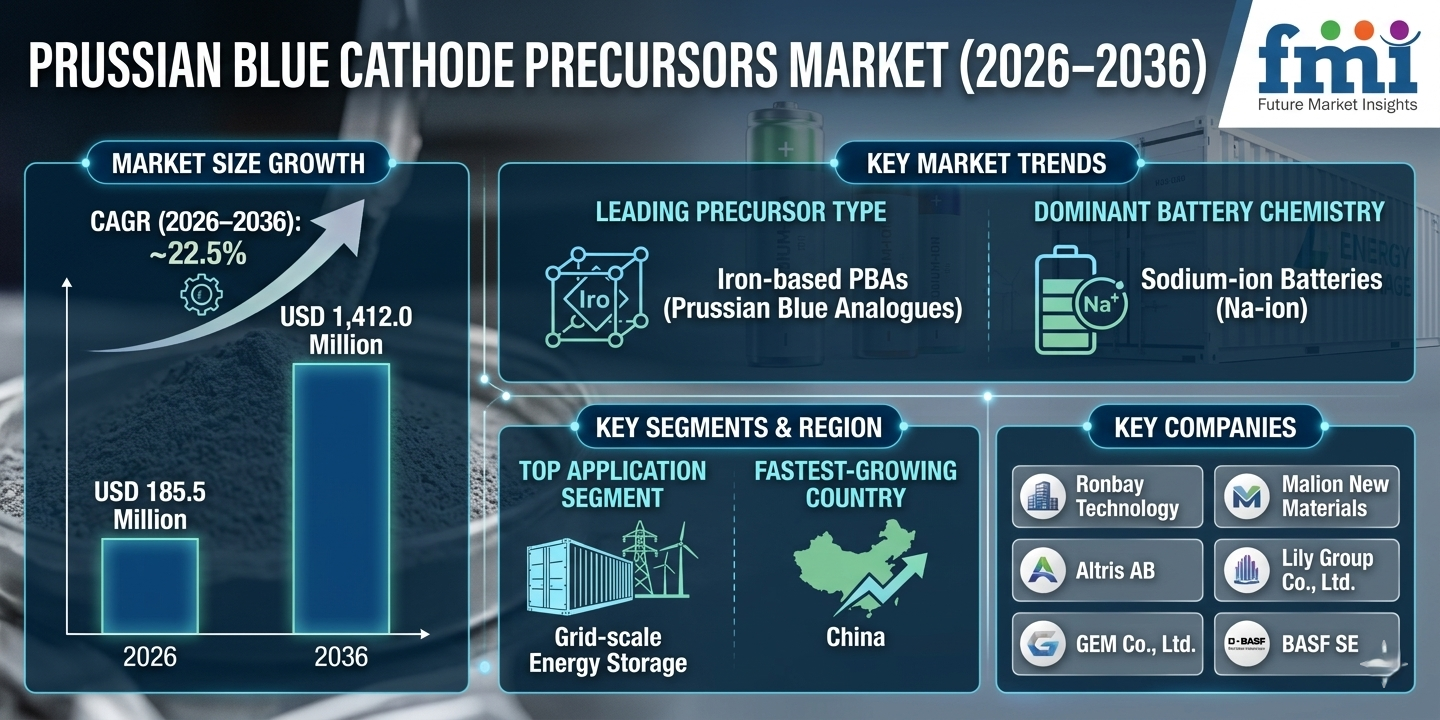
NEWARK, DE, UNITED STATES, March 18, 2026 /EINPresswire.com/ -- The global Prussian Blue Cathode Precursors Market is valued at USD 185.5 million in 2026 and is projected to reach USD 1,412.0 million by 2036, expanding at a CAGR of 22.5% from 2026 to 2036. Growth is driven by the rapid commercialization of sodium-ion batteries, increasing pressure to reduce reliance on lithium supply chains, and the need for cost-efficient materials in utility-scale energy storage deployments.
As battery manufacturers transition toward alternative chemistries, Prussian blue precursors are evolving from laboratory materials into industrial-scale electrochemical inputs—becoming a foundational component in next-generation energy storage systems.
Prussian Blue Cathode Precursors Market Snapshot (2026–2036)
• Market size in 2026: USD 185.5 million
• Market size in 2036: USD 1,412.0 million
• CAGR (2026–2036): ~22.5%
• Leading precursor type: Iron-based PBAs
• Top application segment: Grid-scale energy storage
• Dominant battery chemistry: Sodium-ion batteries
• Fastest-growing country: China
• Key companies: BASF SE, GEM Co., Ltd., Ronbay Technology, Altris AB
Market Momentum
The Prussian Blue Cathode Precursors Market begins at USD 185.5 million in 2026, supported by early-stage commercialization of sodium-ion battery technologies and increasing pilot-scale deployments in grid storage projects. Between 2028 and 2030, rapid gigafactory expansion and lithium substitution strategies significantly accelerate demand.
Entering 2032 and beyond, advancements in continuous synthesis, crystallization control, and defect-free material production reinforce large-scale adoption. By 2036, the market surpasses USD 1.4 billion, driven by widespread integration into stationary energy storage systems and emerging electric mobility applications.
Request For Sample Report | Customize Report |purchase Full Report - https://www.futuremarketinsights.com/reports/sample/rep-gb-32261
Why the Market is Growing
The market is expanding as energy storage developers aggressively pursue alternatives to lithium-based chemistries. Volatility in lithium carbonate pricing and supply chain vulnerabilities are pushing manufacturers toward earth-abundant materials such as iron and sodium.
Prussian blue precursors provide a structurally stable, low-cost framework capable of supporting large-scale battery deployments. Their open lattice structure enables efficient ion transport, while their reliance on abundant raw materials ensures long-term cost predictability.
At the same time, grid operators demand ultra-low capital expenditure solutions for renewable energy integration. These requirements position iron-based cathode materials as a preferred option for multi-megawatt storage installations.
Segment Spotlight
1. Application: Grid-Scale Energy Storage Leads Demand
Grid-scale energy storage accounts for approximately 48% of total demand, driven by the need for cost-effective and safe battery systems for renewable energy balancing.
2. Precursor Type: Iron-Based PBAs Dominate
Iron-based Prussian Blue Analogues (PBAs) represent around 55% of the market, reflecting their cost advantage and abundance compared to nickel or cobalt-based alternatives.
3. Battery Type: Sodium-Ion Batteries Take the Lead
Sodium-ion batteries hold nearly 88% share, supported by strong commercialization efforts to replace lithium-ion systems in stationary and light mobility applications.
Drivers, Opportunities, Trends, Challenges
Drivers:
• Lithium price volatility and supply chain risks
• Expansion of grid-scale energy storage infrastructure
• Demand for earth-abundant battery materials
Opportunities:
• Continuous co-precipitation reactor technologies
• Defect-free crystallization and chelating innovations
• Localized precursor manufacturing near gigafactories
Trends:
• Shift from batch to continuous synthesis processes
• Increasing focus on defect control and moisture management
• Strategic partnerships between chemical suppliers and battery OEMs
Challenges:
• Interstitial water defects impacting battery performance
• High capital requirements for advanced synthesis systems
• Strict qualification standards for battery-grade materials
Country Growth Outlook (2026–2036)
China leads with a projected 32.0% CAGR, supported by strong government backing and large-scale sodium-ion battery commercialization. India follows at 28.5%, driven by domestic resource availability and grid storage initiatives. The United States grows at 20.5%, benefiting from supply chain localization policies.
Germany (19.0%) and Japan (18.5%) maintain steady growth through advanced materials engineering, while South Korea (16.0%) and the UK (15.5%) expand through strategic diversification into alternative battery chemistries.
Competitive Landscape
The market features a mix of specialty chemical companies and advanced battery material developers competing on crystallization control, moisture elimination, and scalable production capabilities.
Key players such as Malion New Materials, Ronbay Technology, Altris AB, GEM Co., Ltd., and BASF SE are investing in continuous processing technologies and advanced chelation methods.
Competition increasingly centers on batch consistency, defect-free lattice structures, and the ability to scale production without compromising electrochemical performance. Suppliers capable of delivering high-purity materials with predictable performance are gaining a strong advantage in early-stage customer qualification cycles.
Frequently Asked Questions (FAQ)
What is the global Prussian Blue Cathode Precursors Market size?
The market is valued at approximately USD 185.5 million in 2026 and is projected to reach USD 1,412.0 million by 2036.
At what rate is the market expected to grow?
The market is forecast to expand at a CAGR of about 22.5% from 2026 to 2036.
What are Prussian blue cathode precursors?
They are battery-grade hexacyanoferrate coordination polymers used as active materials in sodium-ion and other alkali-ion batteries.
Why are these materials gaining importance?
They enable low-cost, scalable, and lithium-free energy storage solutions while maintaining stable electrochemical performance for grid and industrial applications.
Explore More Related Studies Published by FMI Research:
High-Tenacity Cellulosic Staple Fiber Market https://www.futuremarketinsights.com/reports/high-tenacity-cellulosic-staple-fiber-market
Mono-Material Recyclable Stretch Yarn Market https://www.futuremarketinsights.com/reports/mono-material-recyclable-stretch-yarn-market
Dope-Dyed Recycled Polyester Market https://www.futuremarketinsights.com/reports/dope-dyed-recycled-polyester-market
About Future Market Insights (FMI)
Fture Market Insights, Inc. (FMI) is an ESOMAR-certified, ISO 9001:2015 market research and consulting organization, trusted by Fortune 500 clients and global enterprises. With operations in the U.S., UK, India, and Dubai, FMI provides data-backed insights and strategic intelligence across 30+ industries and 1200 markets worldwide.
Why Choose FMI: https://www.futuremarketinsights.com/why-fmi
Sudip Saha
Future Market Insights Inc.
+1 347-918-3531
rahul.singh@futuremarketinsights.com
Legal Disclaimer:
EIN Presswire provides this news content "as is" without warranty of any kind. We do not accept any responsibility or liability for the accuracy, content, images, videos, licenses, completeness, legality, or reliability of the information contained in this article. If you have any complaints or copyright issues related to this article, kindly contact the author above.
