

Hard Carbon Anode Materials Market Intelligence Report: Price Forecast and Growth Drivers (2026–2036)
Rapid commercialization of sodium-ion batteries and gigafactory-scale production accelerates demand for high-performance hard carbon materials
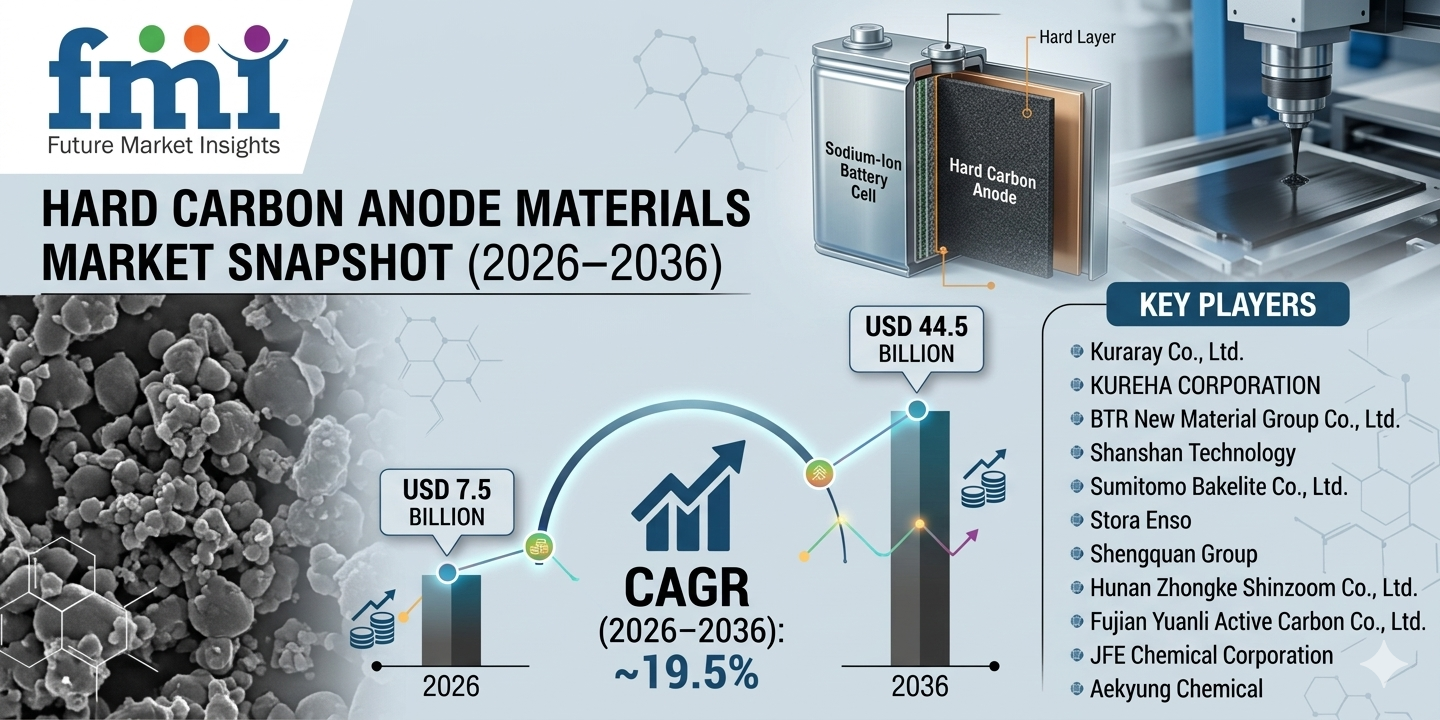
NEWARK, DE, UNITED STATES, March 18, 2026 /EINPresswire.com/ -- The global Hard Carbon Anode Materials Market, valued at USD 7.5 billion in 2026, is projected to surge to USD 44.5 billion by 2036, expanding at a robust CAGR of 19.5% during the forecast period. This remarkable growth trajectory is fueled by the rapid scale-up of sodium-ion battery technologies, increasing pressure to diversify away from lithium-based chemistries, and the emergence of large-scale energy storage systems.
As the battery industry transitions from lab-scale innovation to industrial-scale deployment, hard carbon anode materials are evolving into a foundational component of next-generation energy storage systems. Their ability to support sodium-ion intercalation positions them as indispensable in enabling cost-effective, scalable, and geopolitically resilient battery supply chains.
Hard Carbon Anode Materials Market Snapshot (2026–2036)
• Market size in 2026: USD 7.5 billion
• Market size in 2036: USD 44.5 billion
• CAGR (2026–2036): ~19.5%
• Leading precursor type: Bio-based materials
• Top battery segment: Sodium-ion batteries
• Dominant synthesis method: Pyrolysis
• Fastest-growing region: East Asia
• Key players: Global chemical processors and battery material innovators
Market Momentum
The market begins its high-growth phase in 2026 at USD 7.5 billion, supported by early commercialization of sodium-ion batteries and pilot-scale hard carbon production. Between 2028 and 2032, rapid expansion of gigafactories and grid-scale storage projects drives exponential demand for reliable, high-volume anode materials.
By 2032 and beyond, the focus shifts toward process optimization, microstructural consistency, and long-term supply agreements. As sodium-ion batteries approach cost parity with lithium iron phosphate (LFP), hard carbon becomes a critical bottleneck material. By 2036, the market reaches USD 44.5 billion, firmly embedded in global energy storage infrastructure.
Request For Sample Report | Customize Report |purchase Full Report - https://www.futuremarketinsights.com/reports/sample/rep-gb-32265
Why the Market is Growing
The Hard Carbon Anode Materials Market is expanding due to the structural limitations of graphite in sodium-ion batteries. Unlike lithium ions, sodium ions require larger interlayer spacing, which only hard carbon materials can provide.
Energy storage manufacturers are increasingly adopting sodium-ion technologies to mitigate lithium supply risks and reduce overall battery costs. This shift creates a direct and non-substitutable demand for hard carbon materials.
Additionally, the abundance of biomass and industrial byproducts enables localized production, reducing reliance on geographically concentrated raw materials. This enhances supply chain resilience while supporting national energy security goals.
Rather than being a niche material, hard carbon is now a strategic industrial input essential for scaling alternative battery chemistries.
Segment Spotlight
1. Battery Technology: Sodium-Ion Batteries Lead Demand
Sodium-ion batteries account for approximately 62% of market demand in 2026, driven by their structural dependence on hard carbon anodes and increasing deployment in stationary storage and mobility applications.
2. Precursor Source: Bio-Based Materials Dominate
Bio-based precursors hold around 45% share, supported by their low cost, widespread availability, and favorable pore structure for ion diffusion.
3. Synthesis Method: Pyrolysis Remains Core Process
Pyrolysis accounts for nearly 58% of production, as it provides the scalability and thermal control required to produce high-performance hard carbon at industrial volumes.
Drivers, Opportunities, Trends, Challenges
• Drivers: Sodium-ion battery commercialization, lithium supply constraints, grid-scale energy storage demand
• Opportunities: Biomass-based precursor integration, closed-loop carbonization systems, solid-state battery compatibility
• Trends: Multi-supplier qualification strategies, localization of supply chains, performance optimization at scale
• Challenges: Initial coulombic inefficiency, microstructural inconsistency, high capital requirements for carbonization infrastructure
Country Growth Outlook (2026–2036)
China leads global expansion with a CAGR of 22.0%, driven by aggressive deployment of sodium-ion storage systems and strong state support. Japan follows at 21.0%, leveraging advanced material engineering expertise, while South Korea grows at 20.0% through supply chain diversification.
The United States records 18.0% growth due to domestic sourcing initiatives and federal incentives. Germany and the United Kingdom expand at 17.0% and 15.0%, respectively, supported by renewable energy integration and automotive transitions. India also emerges as a key growth market at 14.0%, fueled by grid modernization and localized manufacturing initiatives.
Competitive Landscape
The market is moderately consolidated, with leading players competing on microstructural consistency, large-scale production capability, and precursor integration. Companies such as Kuraray, KUREHA Corporation, BTR New Material Group, and Shanshan Technology dominate through advanced carbonization expertise and vertically integrated supply chains.
Competition increasingly centers on achieving batch-to-batch consistency at the 10,000-ton scale, optimizing energy efficiency in production, and securing long-term supply agreements with battery manufacturers. Emerging players are gaining traction by leveraging bio-based feedstocks and localized production advantages.
Frequently Asked Questions (FAQ)
What is the global Hard Carbon Anode Materials Market size?
The market is valued at USD 7.5 billion in 2026 and is projected to reach USD 44.5 billion by 2036.
What is the expected growth rate?
The market is forecast to grow at a CAGR of approximately 19.5% from 2026 to 2036.
What are hard carbon anode materials?
They are non-graphitizing carbon materials with disordered structures designed to accommodate large alkali ions, particularly sodium, in battery applications.
Why are hard carbon materials critical for sodium-ion batteries?
Because traditional graphite cannot structurally accommodate sodium ions, hard carbon becomes essential for enabling efficient and stable battery performance.
Explore More Related Studies Published by FMI Research:
Antimicrobial Additives Market https://www.futuremarketinsights.com/reports/global-antimicrobial-additives-market
Bromine Derivative Market https://www.futuremarketinsights.com/reports/bromine-derivatives-market
Geocells Market https://www.futuremarketinsights.com/reports/geocells-market
About Future Market Insights (FMI)
Fture Market Insights, Inc. (FMI) is an ESOMAR-certified, ISO 9001:2015 market research and consulting organization, trusted by Fortune 500 clients and global enterprises. With operations in the U.S., UK, India, and Dubai, FMI provides data-backed insights and strategic intelligence across 30+ industries and 1200 markets worldwide.
Why Choose FMI: https://www.futuremarketinsights.com/why-fmi
Sudip Saha
Future Market Insights Inc.
+1 347-918-3531
rahul.singh@futuremarketinsights.com
Legal Disclaimer:
EIN Presswire provides this news content "as is" without warranty of any kind. We do not accept any responsibility or liability for the accuracy, content, images, videos, licenses, completeness, legality, or reliability of the information contained in this article. If you have any complaints or copyright issues related to this article, kindly contact the author above.
