

CNaught Launches Carbonlog, the First Tool to Track the Carbon Footprint of AI-Assisted Software Development
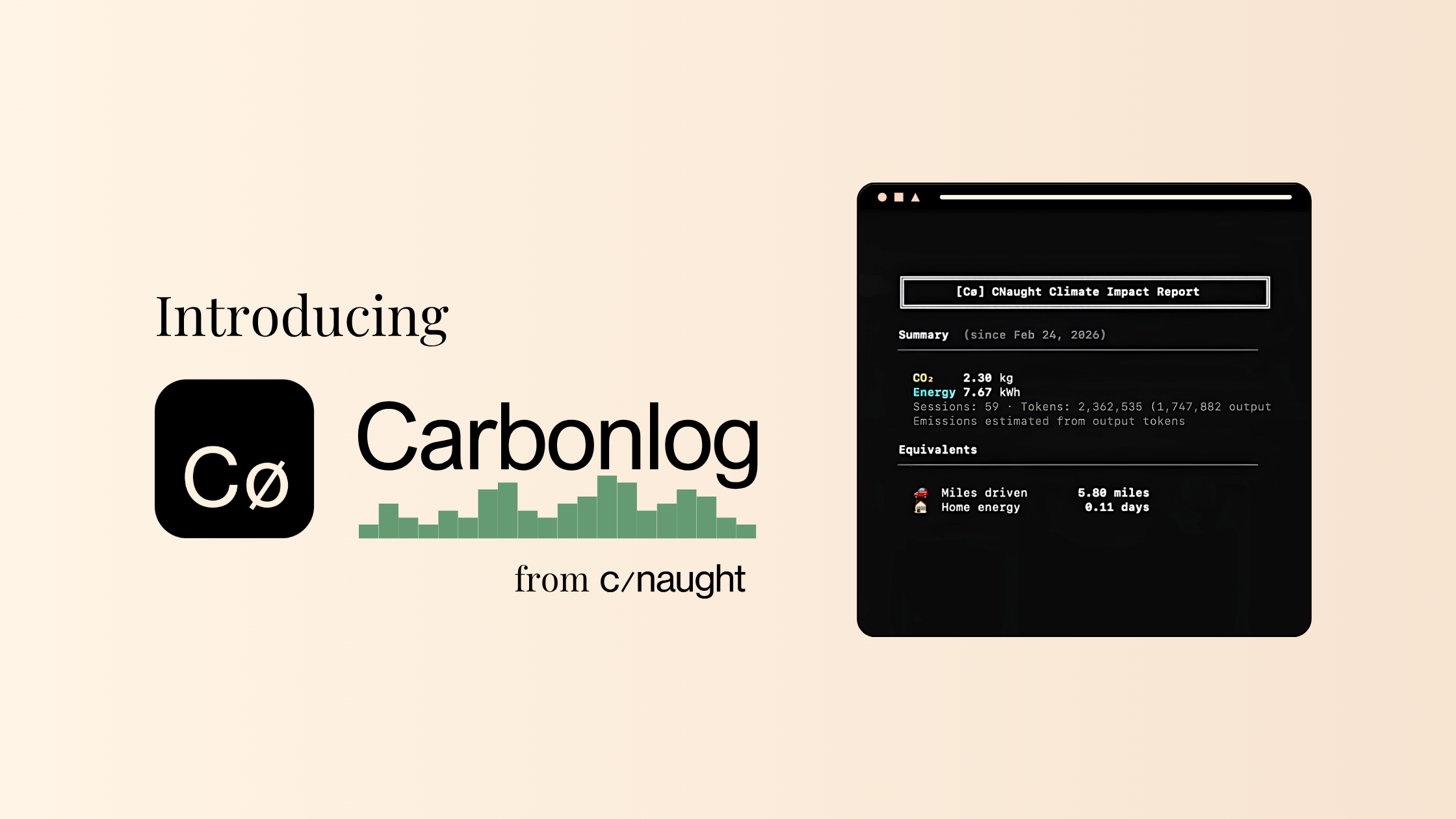
Introducing Carbonlog | An Open-Source Claude Code Plugin from CNaught
Real-time visibility into the carbon cost of AI-assisted coding, powered by independent academic research
SAN FRANCISCO, CA, UNITED STATES, March 25, 2026 /EINPresswire.com/ -- AI coding tools have reshaped how software gets built. Yet the environmental cost of this shift is almost entirely unmeasured: ten of thirteen major AI companies disclose nothing about the environmental impact of building and deploying their models, according to Stanford’s 2025 Foundation Model Transparency Index.
Today, CNaught is launching Carbonlog, an open-source Claude Code plugin that tracks the carbon emissions and energy consumption of AI-assisted coding sessions in real time. It is the first developer tool to provide per-session emissions data based on independent academic research.
A Growing Footprint with No Visibility
The scale of AI’s environmental impact is becoming clearer. The International Energy Agency projects that global electricity demand from data centers will more than double by 2030, reaching 945 terawatt-hours (TWh), more than Japan’s total electricity consumption today. Goldman Sachs Research estimates that if 60% of new data center power demand is met by natural gas, the resulting emissions increase could reach 215–220 million tonnes of CO₂ by 2030.
Until now, developers haven't had an easy way to measure their contribution to this footprint. Estimation methodologies exist in the academic literature, but building them into a usable tool has been left as an exercise for the climate-conscious developer. CNaught has taken the best available methodology and made it turnkey: install one plugin, and see your emissions every time you submit a query.
CNaught is committed to using the best available science and keeping the methodology current as the research evolves, so teams don't have to track the literature themselves. The underlying framework is already being updated as new model benchmarks become available.
What Carbonlog Does
Carbonlog runs as a Claude Code plugin, estimating the energy consumption and CO₂ emissions of each API request in real time. A subtle status line displays cumulative emissions as developers work. An on-demand report provides breakdowns by model, project, and time period, with relatable equivalents like car-miles driven and days of household energy usage.
The plugin’s calculations are based on Jegham et al. (2025) “How Hungry is AI? Benchmarking Energy, Water, and Carbon Footprint of LLM Inference.” This framework estimates energy from first principles using real-time performance benchmarks, statistically inferred hardware configurations, and provider-specific infrastructure parameters.
All data is stored locally by default. No code, conversation content, or personal information is shared. Developers can optionally enable anonymous metric sync for team-level benchmarking through CNaught.
Why It Matters Now
California’s SB 253 will require companies with over $1 billion in revenue to report Scope 3 emissions starting in 2027. For organizations using AI inference as a purchased service, those emissions typically fall under Scope 3, Category 1: Purchased Goods and Services. Carbonlog provides the data needed to establish a baseline before reporting requirements take effect.
What Comes Next
Carbonlog is currently in beta with a group of design partners. Installation takes approximately 30 seconds.
Carbonlog launches as a Claude Code plugin, with plans to expand to other AI coding tools and chat-based LLM usage. Beyond measurement, CNaught is exploring how Carbonlog can move from visibility to recommendations on how to build greener software.
Availability
Carbonlog is open source. Developers can install it today from CNaught’s Claude Code plugin marketplace. For a detailed methodology breakdown and reporting guidance for sustainability teams, read the full announcement on the CNaught blog. For organizations interested in understanding their AI emissions at a holistic level, contact CNaught at cnaught.com/contact-sales.
About CNaught
CNaught is a carbon credit platform that helps companies of all sizes use high-integrity carbon credits with confidence. Leveraging a science-backed portfolio approach, CNaught simplifies the complex carbon landscape and provides the tools and expertise businesses need to make climate-positive decisions with limited sustainability resources. For more information, go to www.cnaught.com.
Caitlin McGarry
CNaught
info@cnaught.com
Visit us on social media:
LinkedIn
Other
Legal Disclaimer:
EIN Presswire provides this news content "as is" without warranty of any kind. We do not accept any responsibility or liability for the accuracy, content, images, videos, licenses, completeness, legality, or reliability of the information contained in this article. If you have any complaints or copyright issues related to this article, kindly contact the author above.
