

High-speed and large-capacity visible light communication for 6G: advances and perspectives
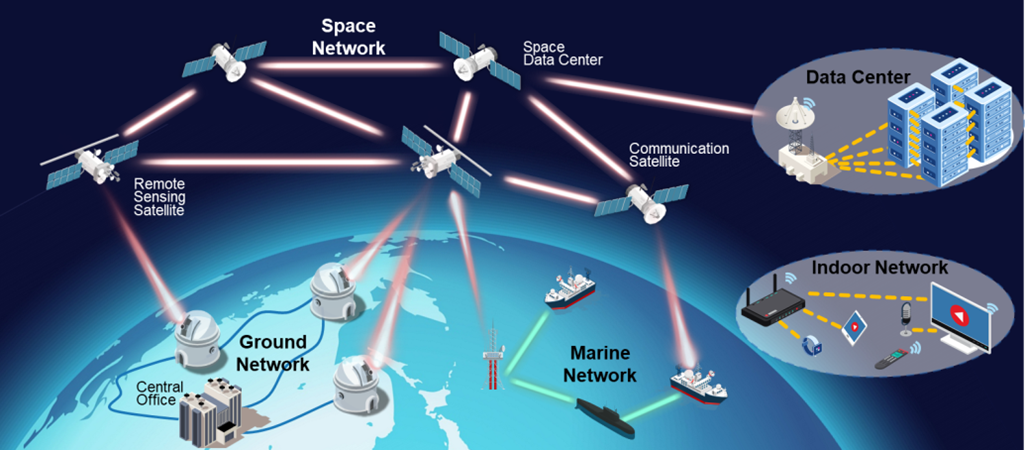
Fig. 1. Application scenarios of visible light communication in space, ground, underwater, data center, and indoor networks.
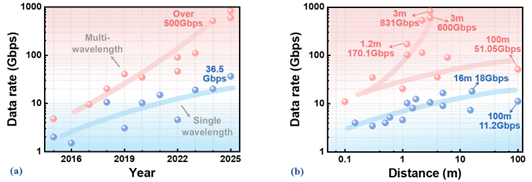
Fig. 2. Representative achievements in high-speed visible light communication in recent years.
A new publication from OET DOI 10.29026/oet.2026.260004, discusses advances and perspectives on high-speed and large-capacity visible light communication for 6G
SHANNON, CLARE, IRELAND, April 6, 2026 /EINPresswire.com/ -- A new publication from Opto-Electronic Technology; DOI 10.29026/oet.2026.260004, discusses advances and perspectives on high-speed and large-capacity visible light communication for 6G.
With the evolution of the sixth-generation (6G) mobile communication toward a space-air-ground-sea integrated network, massive data-centric applications, such as augmented/virtual reality (AR/VR), digital twins, and artificial intelligence, are imposing unprecedented demands on communication systems in terms of capacity, data rate, and latency. However, conventional radio-frequency spectrum resources are becoming increasingly scarce. In this context, visible light communication (VLC), which exploits the 380-780 nm optical spectrum, has emerged as a promising wireless optical communication technology. Owing to its abundant spectrum resources, strong immunity to electromagnetic interference, and potential for ultra-high-speed transmission, VLC has attracted extensive research interest.
The primary driving force of this work lies in overcoming the capacity limitations of traditional communication systems and exploring new paradigms for large-capacity, high-speed wireless transmission tailored for 6G. The core objective is to systematically review key advances in VLC from the perspectives of devices, algorithms, and system architectures, thereby establishing a comprehensive technological framework to support large-capacity communication.
This research is of significant importance. On the one hand, the visible light spectrum provides a new avenue for capacity scaling in future wireless communications. On the other hand, VLC demonstrates unique advantages in diverse application scenarios, including inter-satellite links, underwater communications, and data center interconnects, making it a strong candidate as a key enabling technology for 6G.
Visible light communication exhibits unique application potential across a wide range of scenarios, including space, ground, underwater, and data center environments, as illustrated in Fig. 1. To address the capacity requirements of 6G, this review systematically summarizes the development of VLC from three key dimensions: devices, signal processing algorithms, and system architectures.
At the device level, research efforts focus on enhancing the bandwidth and efficiency of both transmitters and receivers. On the transmitter side, technologies have evolved from conventional light-emitting diodes (LEDs) to micro-LEDs and laser diodes (LDs). Through structural design and cavity-length optimization, bandwidths in the GHz regime or higher have been achieved, with single-channel data rates exceeding 36.5 Gbps. Furthermore, large-scale device arrays are driving system parallelization, paving the way toward Tbps-level potential capacity. On the receiver side, GaN-based photodetectors, avalanche photodiodes, and single-photon detectors have significantly improved sensitivity and data rates. Array-based receiver designs further expand the field of view and enhance system robustness.
In terms of signal processing, various advanced modulation and equalization techniques have been developed to mitigate bandwidth limitations and nonlinear distortions. High-order modulation schemes, multidimensional coding, and spectral compression techniques substantially improve spectral efficiency. Channel estimation methods have evolved from traditional approaches toward physics-informed deep learning models, enabling more accurate characterization of complex channels. Meanwhile, hybrid equalization strategies combining pre- and post-equalization, particularly those assisted by neural networks, effectively compensate for nonlinearities and bandwidth constraints, thereby improving overall system performance.
At the system and network level, multidimensional multiplexing and multi-aperture reception have become key enablers for achieving large-capacity transmission. By exploiting wavelength, polarization, spatial, and mode division multiplexing, system data rates have increased to beyond 800 Gbps. In addition, multi-aperture reception and beamforming techniques significantly enhance turbulence resilience and spatial multiplexing capability, improving link stability. Recent advances in VLC are summarized in Fig. 2, where multidimensional parallel architectures combined with techniques such as wavelength-division multiplexing (WDM) have emerged as a dominant trend, driving VLC toward Tbps-level performance.
In recent years, significant progress has been achieved in VLC in terms of device performance, algorithm optimization, and system architecture, laying a solid foundation for practical deployment. Future research will focus on perception-assisted predictive communication, optical field manipulation technologies, inter-satellite communication, and visible-light photonic integration. Through multidimensional co-optimization and chip-level integration, VLC is expected to achieve higher capacity and enhanced robustness, ultimately serving as a key enabling technology for 6G.
Funding: This work was supported by the National Natural Science Foundation of China (Grant No. 62525102).
Keywords: visible light communication, high-speed, large-capacity
# # # # # #
Nan Chi is a Professor and Ph.D. supervisor at Fudan University, a recipient of the National Science Fund for Distinguished Young Scholars, and a Fellow of the Optical Society of America (OSA). She serves as a committee member of the Optical Communication Committee of the China Institute of Communications (CIC), Vice Chair of the Underwater Communication Committee, Vice Chair of the Communication Society of the Chinese Institute of Electronics, and Vice Chair of the Circuits and Systems Society. Her research has focused on high-speed visible light communication. She has published over 450 papers, with more than 17,000 citations on Google Scholar and an H-index of 63. She has authored 10 monographs on high-speed optical communication, including books that have been selected for major publishing programs such as the National Key Publishing Project of the 14th Five-Year Plan by the National Press and Publication Administration, the Major National Publications of the 13th Five-Year Plan, and the Top 100 High-Quality Textbooks of Fudan University. She has been listed among the “World’s Top 2% Scientists” for three consecutive years and named an Elsevier “Highly Cited Chinese Researcher” for four consecutive years. Her honors include the First Prize of Natural Science from the China Institute of Communications, the First Prize of Science and Technology Progress from Henan Province, and the First Prize of Science and Technology Progress from the Chinese Society for Optical Engineering.
# # # # # #
Opto-Electronic Technology (OET) is an international, peer-reviewed and open access English language journal. OET publishes reviews, research articles and letters covering engineering technologies and applications of optics, photonics and optoelectronics.
# # # # # #
More information: https://www.oejournal.org/oet/en/
Editorial Board: https://www.oejournal.org/oet/en/editorial_board/oetEditorialBoard
All issues available in the online archive (https://www.oejournal.org/oet/archive_list_en)
Submission of OET may be made using ScholarOne (https://mc03.manuscriptcentral.com/oet)
ISSN (Print) 2097-6003
CN 51-1811/O4
Contact Us: oet@ioe.ac.cn
Twitter: @OptoElectronAdv (https://twitter.com/OptoElectronAdv?lang=en)
WeChat: OE_Journal
# # # # # #
Chi N, Lu Z L, Li F J et al. High-speed and large-capacity visible light communication for 6G: advances and perspectives. Opto-Electron Technol 2, 260004 (2026). DOI: 10.29026/oet.2026.260004
Opto-Electronic Technology Editorial Office
Opto-Electronic Technology
123456789
email us here
Legal Disclaimer:
EIN Presswire provides this news content "as is" without warranty of any kind. We do not accept any responsibility or liability for the accuracy, content, images, videos, licenses, completeness, legality, or reliability of the information contained in this article. If you have any complaints or copyright issues related to this article, kindly contact the author above.
