

Breast Cancer Treatment for Young Women: New 2026 Evidence Digest Highlights Emerging Advances in BCYW Treatment
Advances in BCYW Treatment
Where BCYW Treatment is Heading

2026 Evidence Digest on Advances in BCYW Treatment
The BCYW Foundation examines 14 completed studies and reviews what’s next in breast cancer treatment and the unanswered questions for young premenopausal women.
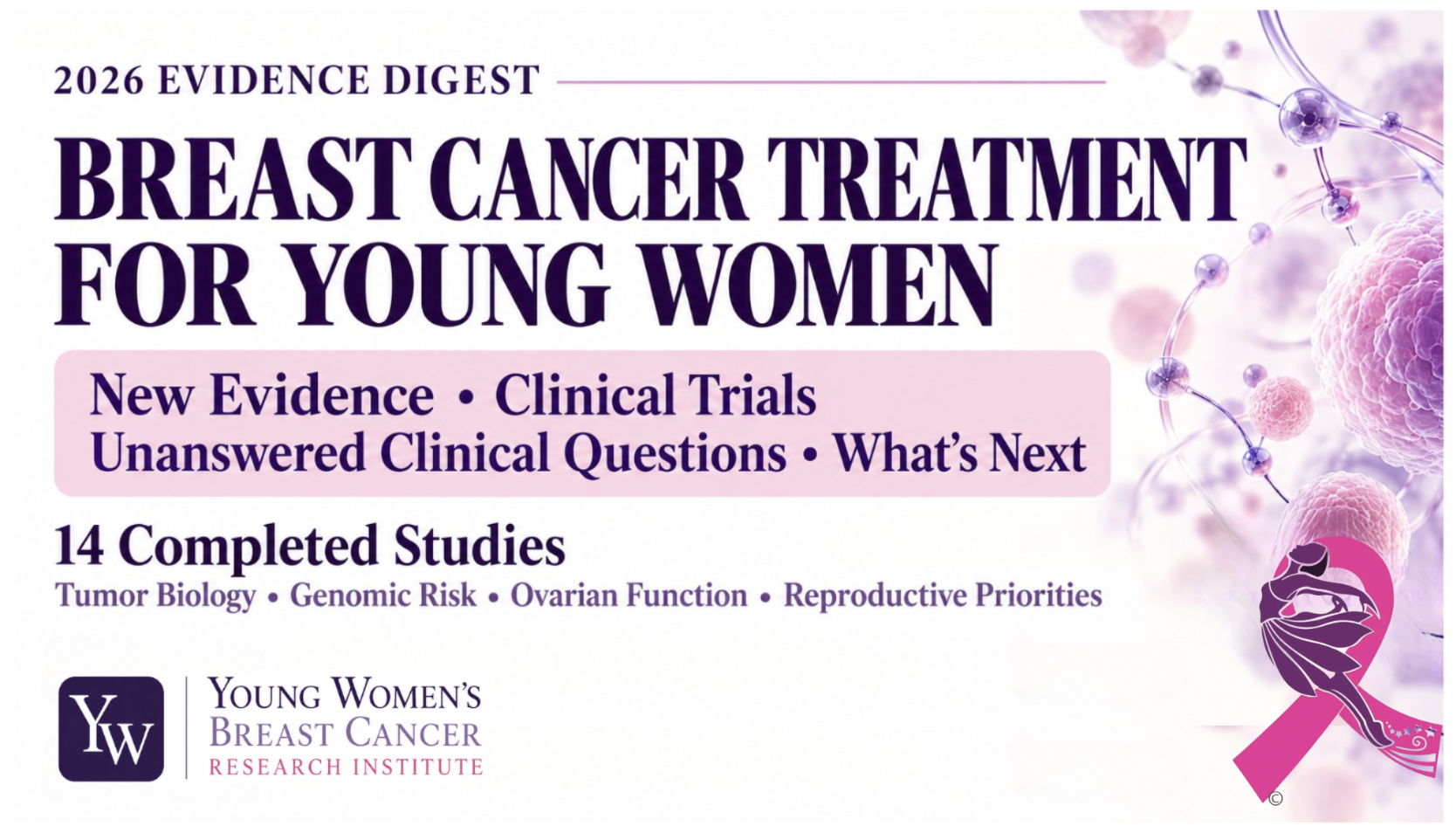
DENVER, CO, UNITED STATES, October 20, 2026 /EINPresswire.com/ -- The Young Women’s Breast Cancer Research Institute (YWBCRI) and the Breast Cancer in Young Women Foundation (BCYW Foundation) have released the Breast Cancer Treatment for Young Women: New 2026 Evidence Digest Highlights Emerging BCYW Treatment Advances, a digital publication that reviews recent treatment studies particularly relevant to younger and premenopausal women.The digest summarizes 14 completed studies on endocrine therapy, genomic treatment guidance, ovarian function and suppression, fertility preservation, pregnancy, targeted therapy, and emerging molecular approaches to treatment resistance. A final section highlights five ongoing trials listed by the National Cancer Institute that may help shape the next generation of breast cancer treatment for young and premenopausal women. The publication also includes an editorial introduction, summaries of all 14 studies, a synthesis of the evidence, current research gaps, treatment implications, and a look ahead at what may come next in clinical research.
FOURTEEN STUDIES ACROSS A CHANGING TREATMENT LANDSCAPE
The completed studies featured in the digest address key questions in contemporary breast cancer treatment. Long-term trials support ovarian suppression and endocrine combinations for premenopausal women with hormone receptor-positive disease. Other studies test whether adding CDK4/6 inhibitors to adjuvant endocrine therapy reduces recurrence or improves outcomes in advanced disease. Genomic tools are used to identify which premenopausal patients benefit from chemotherapy versus endocrine therapy—and whether chemotherapy’s benefit in younger women stems from killing tumor cells or from suppressing ovarian function.
The digest also treats ovarian function as an outcome, not just a side effect. It examines ovarian suppression, chemotherapy’s impact on ovarian reserve, and fertility preservation. For young women, success means controlling breast cancer while preserving reproductive options and enabling informed pregnancy decisions.
Studies examine pausing endocrine therapy to pursue pregnancy, newer endocrine agents and molecularly targeted treatments, and responses to changes during therapy. Together, they show an increasingly adaptive treatment landscape.
WHAT’S NEXT IN BREAST CANCER TREATMENT? UNANSWERED QUESTIONS FOR PREMENOPAUSAL WOMEN
The publication’s final section highlights five ongoing National Cancer Institute trials focused on questions relevant to premenopausal or younger women.
These studies examine ways to optimize suppression of ovarian function, determine whether some premenopausal patients can safely avoid chemotherapy, evaluate next-generation endocrine therapy, and explore pharmacologic approaches to breast cancer prevention.
Their significance extends beyond the interventions under investigation. The next generation of research is beginning to study premenopausal biology directly, rather than simply enrolling young women in trials designed for patients of all ages.
This shift may help generate evidence that better reflects the biological, endocrine, and reproductive contexts of younger women. Trial availability and recruitment status can change, and the study team and treating clinicians must determine eligibility.
MOVING FORWARD FROM FIXED TREATMENT PATHWAYS
“Breast cancer treatment for young women must integrate tumor biology with ovarian function, genomic risk, and reproductive priorities to provide care that is both effective and personally meaningful,” said Luis Costa, MD, PhD, Clinical Director of YWBCRI, Director of the YWBCRI-FMUL site, and Founding Director of the BCYW Foundation.
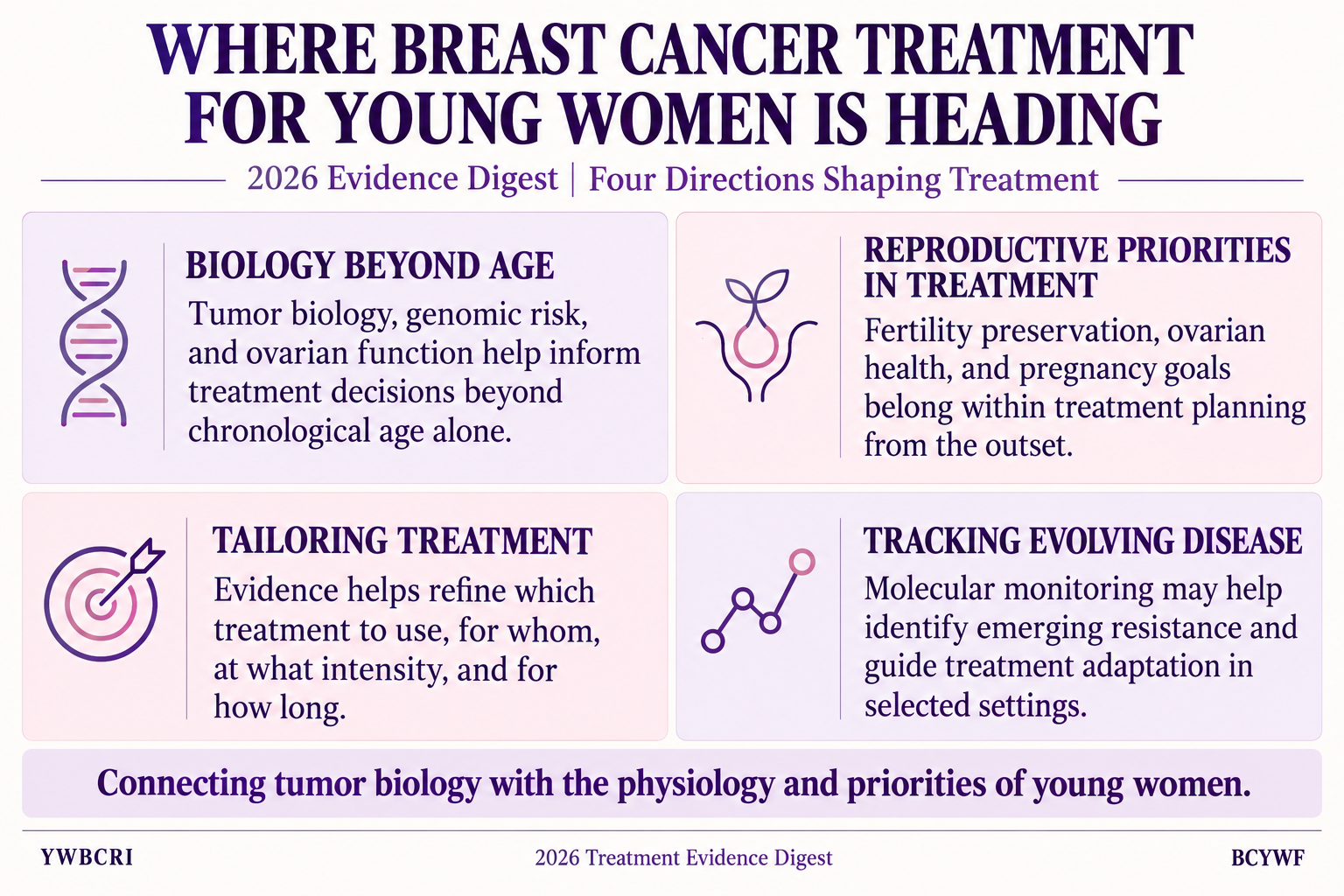
Treatment at a younger age is not simply the same treatment delivered earlier. Treatment decisions can affect ovarian function, fertility, pregnancy planning, endocrine health, bone and cardiovascular health, sexual well-being, family formation, and long-term quality of life. At the same time, tumors in younger women may differ in subtype, genomic risk, clinical presentation, and response to treatment. The new evidence digest examines a broader shift in how breast cancer treatment for young women is understood: the field is moving beyond simply applying standard breast cancer therapies to younger patients. Increasingly, treatment must account for the interplay among tumor biology, ovarian function, endocrine state, genomic risk, reproductive priorities, and molecular evolution during therapy.
“Advancing breast cancer treatment for young women requires us to connect tumor biology and genomic risk with ovarian function, endocrine physiology, and reproductive priorities. The challenge is to translate that current understanding into better decisions about which treatment to use, for whom, and for how long—and to design studies that resolve the questions still unanswered for this population.” —Rakesh Kumar, PhD, Scientific Director of YWBCRI and the President of the Breast Cancer in Young Women Foundation.
PRESERVING THE SERIES AS AN EDUCATIONAL RESOURCE
This digital digest brings the series together, enabling clinicians, researchers, advocates, patients, students, and the public to review the evidence, distinguish completed studies from ongoing research, and revisit findings as treatment evolves. Its synthesis highlights that progress in treating young women with breast cancer depends on integrating tumor biology, premenopausal physiology, genomic risk, ovarian function, reproductive goals, and treatment-related molecular changes. The field is moving not toward more treatment but toward care that is selective, adaptive, biologically informed, and responsive to young women’s lives.
The publication was edited by Rakesh Kumar, PhD; Luis Costa, MD, PhD; Vijian Dhevan, MD; and Francisco J. Esteva, MD, PhD.
ACCESS THE EVIDENCE DIGEST
The digital book is available without charge through the websites of both organizations:
Young Women’s Breast Cancer Research Institute
https://ywbcri.org
Direct book link: https://breastcancerinyoungwomen.org/docs/evidence-education-library/emerging-advances-breast-cancer-treatment.pdf
Breast Cancer in Young Women: Resources, Evidence and Education Library
https://breastcancerinyoungwomen.org/resources/
ABOUT
The Breast Cancer in Young Women Foundation is a United States–based nonprofit organization dedicated to saving young women's lives through targeted awareness, education, advocacy, early detection, and scientific research. It brings together clinicians, scientists, nurses, survivors, advocates, NGOs, and partners from 35 countries. It advances targeted awareness and research and highlights emerging advances in BCYW through its peer-reviewed, open-access journal, Young Women's Breast Cancer and Health (YWBC). One of the foundation's programs, the Youth Council for Breast Health (YCBH), promotes targeted awareness on educational campuses. Through evidence-based analysis, the Foundation works to improve outcomes and long-term survivorship for young women diagnosed with breast cancer.
The Young Women's Breast Cancer Research Institute (YWBCRI), a research initiative of the BYW Foundation, advances collaborative research on the earliest biological changes that precede breast cancer. It focuses on early breast biology, metabolic drivers, and opportunities to predict risk, prevent disease, and enable early intervention. The Institute aims to connect discoveries about how disease begins with approaches that could help identify and intercept risk earlier.
DISCLAIMER: Featured studies and their accompanying highlights and infographics summarize key findings. For complete study data, methodology, and interpretation, readers should consult the cited original publications. This information is provided for educational purposes only and does not substitute for the need for professional medical advice and consulting a doctor with your concerns and doubts.
Rakesh Kumar, Ph.D., Founder and President
Breast Cancer in Young Women Foundation
bcywf@breastcancerinyoungwomen.org
Visit us on social media:
LinkedIn
Bluesky
Instagram
Facebook
YouTube
Legal Disclaimer:
EIN Presswire provides this news content "as is" without warranty of any kind. We do not accept any responsibility or liability for the accuracy, content, images, videos, licenses, completeness, legality, or reliability of the information contained in this article. If you have any complaints or copyright issues related to this article, kindly contact the author above.
